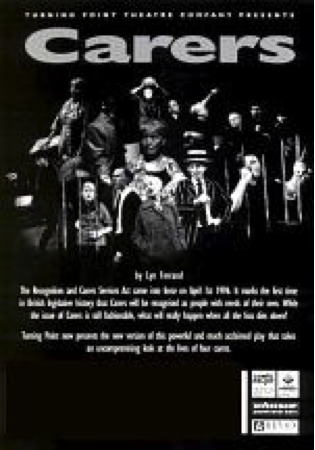
My work with Turning Point Theatre Company enabled me to research and write many plays about health and social issues. I remember one in particular: The Carers Project. It all started after I’d heard a radio programme about the plight of those caring for a friend, spouse of other member of their family on a full-time basis, often providing care for 24/7. There were also young carers, some as young as 7 years old, looking after a parent with a severe disability.
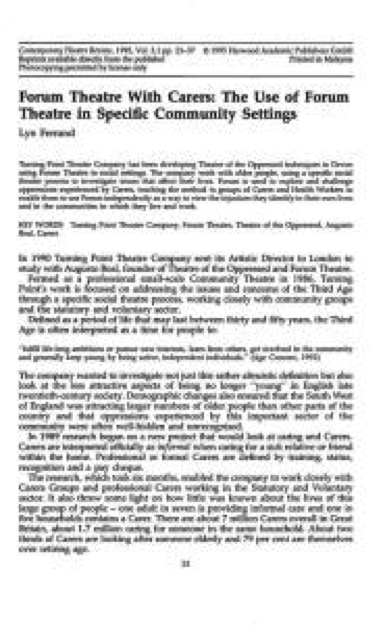
I contacted carer‘s groups and was invited to attend conferences and and meetings and interview carers to get a handle on their lives and the services that were available to help them. I had been commissioned to write an article in Contemporary Theatre Review, about my work usingForum Theatre with carers and health professionals. Information about my article can be found here: http://www.tandfonline.com/
LOOKING BACK – AND FORWARD.
Twenty-five years ago I researched and wrote a play called CARERS. It toured the UK playing to packed houses and nearly made it to the West End. The tickets for the first show came back printed with the word CAREERS. The printer, when questioned on his error, said there was no such word as carer.
At the time, my research into what happened to people when they became carers, sometimes overnight, was based on interviews with carers and what I had seen in my own community and when I worked in a local mental hospital. The imposing Victorian building is no more, converted into luxury flats, though it still looks daunting on the outside. The people living there are not institutionalised and hidden from society, as they were then. Care in the Community was supposed to give those who needed care the ability to stay at home and receive care when it was needed. What has happened to that innovative and compassionate idea?
The elderly are called ‘bed blockers’ and the system is in free-fall. Successive governments have failed catastrophically to address the plight of those who need care and carers who need to be recognised for the work they do and paid accordingly. Local councils do their best. My council have been supportive, though we know cuts from central government make it difficult for them to meet the caring needs of their citizens.
For years our politicians have chosen to side-step the problem and make carers invisible. It feels to me as if becoming old, needing care, asking for help from social services can make you feel as if you are a lesser person. You are bleeding the economy dry because you do not live up to the idealism of a political party: you do not ‘grow the economy’.
This is so wrong. If you look at the whole wide and complicated picture of the world of caring, you might begin to see that one of the ways social care has been addressed for decades has been narrow and tinged with a two-tier mindset. Is there still a class system in the UK? No matter how disingenuous the media are about it, are carers and those they look after lumped together with certain groups: people who can’t work because they ‘say they are sick’, receive benefit payments and others who are considered spongers? We are clearly not ‘growing the economy.’
Being alive means that whatever your social class, finances or education, you will one day expire. It is likely you will also need care before that day arrives and if you are lucky enough to outstay your welcome and become riddled with dementia, mobility issues and incontinence, you will see that our leaders wonder what to do with this army of people who are such a drain on financial resources. It has become a political football that never wins the game.
The burden falls on the state. Well, euthanasia is now being seriously considered in some quarters. Will that become the answer? Today adult children often turn away from caring for their ageing parents because in our culture, this is no longer seen as part of family life. Blended families are the norm, fracturing the long held belief that families care for their elderly. And I agree, it’s not practical because women, who have always done the majority of the caring, now work full-time in order to help their families to simply survive. There is little or no time to look after granny with dementia.
So, are we a civilised society? What does this mean? Compassion has been out of favour for the past fourteen years of Conservative rule in the UK, though they would argue that this is not the case. But I say, why is it that both the NHS and the care system are so crushed? Why are our doctors striking or leaving the country? Why do care workers earn pitifully small wages when they are putting compassion into action? Why do informal carers, looking after a relative or friend at home have to still jump through hoops to get any financial help?
Why do we seem to hate the idea of old age and all that it brings with it? We have constantly denigrated the aged for years. Respect and care for parents as they age is not addressed in schools. In my view, it is something that should not be seen as a burden for families. Our elderly have lived colourful lives. They have wisdom and this should be venerated. In a culture where ‘wisdom’ comes from Meta, TikTok, Instergram and the like, what hope if there for our young people to really understand the beauty of ageing and the end of life process?
Looking after someone is way of giving back, of thanking the people we love for giving us life, for their contributions to society. If this was the message, rather than the current one of making the elderly and those who need care an inconvenience and a financial embarrassment, wouldn’t life be better? It was ironic to see on TV the coverage of the commemoration of the D-Day landings and the way the elderly people who survived the war and who attended the events in France were applauded. It was even more telling that our Prime Minister chose to leave early to use the media to enhance his political ambitions.
If there was a system that really worked, not just in certain post codes, but across the UK, and supported people in their own homes with high value care, not the fifteen minute wash and brush-up we have become used to, how much easier it would be for everyone. If there was a care system that was, at source well thought out, administered efficiently, driven by compassion and funded adequately, everyone would benefit, especially the NHS. My view is that this has to start with our leaders embracing a very different attitude – that compassion and valuing people whoever they are, whatever their age, race and status is as important as ‘growing the economy.’
Our attitude to carers and those they look after has to change. Whether you are an ‘informal’ carer or a professional carer your work must be valued and financially rewarded, respected and recognised as something this country should be really proud of. Syrupy articles in the tabloids and politician’s giving us their own stories about care are not enough. We need a huge change in how our leaders think about the issues.
THE POWER OF DRAMA TO RAISE AWARENESS AND STIMULATE CHANGE.
At the start of 2024, ITV television produced a drama that highlighted the worst injustice against hundreds of people running Post Offices in the UK . The scandal of wrongfully accused and convicted innocent people who had been using a faulty computer system installed by the Post Office has been going on for years. Finally, after the broadcast of the drama, the story has been told to the general public. They are now aware of the horror this group of people have been subjected to and will now finally have the ears of the government, who up until this moment have been slow to act.
I have always been convinced of the way well written and researched drama, be it in film, TV or theatre can raise awareness and promote understanding and ultimately change. My own work focussed on this when I founded Turning Point Theatre Company. At the time, I was often told by the arts fraternity that to write and produce such campaigning theatre wasn’t really art for arts sake. How wrong that was. My plays went to the heart of all sorts of issues and injustices and using the technique of Forum Theatre gave audiences a chance to debate the issues after performances. It bought together the policy makers and those wanting change and allowed them to discuss ways forward. Bold funders financed my work and I thank them for their vision.
My play CARERS was first produced in 1999 and toured the UK. I will never forget the passion with which carers in the audience told their stories and the way those who worked professionally in Social and Health services reacted to hearing these stories in a public arena. My kind of drama did not become popular for some time. Now, thankfully it is mainstream. Powerful and revealing, interactive and seeking realistic resolutions that are actionable, this type of drama will, I hope continue to touch people like nothing else can. Lyn Ferrand. June 2024
I realised after a 3 month period of research that what I was about to do was a daunting task. I applied for funding and received several grants to write and produce a musical play called CARERS. The play toured the UK in 1999/2000 and was very successful. After each performance, usually to an audience of carers and professionals, there would be a discussion with a selected panel of people to answer questions stimulated by watching the play. These discussions were often volatile and placed the members of the panel on the spot many times as they struggled to answer proactively. The play was eventually adapted into another piece of theatre: THE HIGH WIRE OF NEED commissioned by Sandwell Social Services.
Supported by a company of 7 actors and crew, I ran a series of day long workshops over a period of 4 weeks. The workshops included a performance of the adapted play and a Forum Theatre session afterwards. The participants numbered 50/60 people from all health and social services departments. Joined-up thinking was the buzzword!
When I look back at the amount of work I and the company put into The Carers Project and I see how little things have changed since then, I must admit to feeling disappointed. The Carers Project reached so many people and at the time I felt we were really raising awareness and putting carer’s issues before the policy makers and professionals who had the power to make things better. The project won awards and went on to become a training video called TAKE CARE, which is still being used across the UK.
The UK government has promised more money for carers. Any one of us could become a full-time carer overnight. I hope the money is enough and will go some way into helping people look after their loved ones at home. But I doubt it.
Contemporary Theatre Review / 3(1)Download Options
Turning Point Theatre Company has been developing Theatre of the Oppressed techniques in Devon using Forum Theatre in social settings. The company work with older people, using a specific social theatre process to investigate issues that affect their lives. Forum is used to explore and challenge oppressions experienced by Carers, teaching the method to groups of Carers and Health Workers to enable them to use Forum independently as a way to view the injustices they identify in their own lives and in the communities in which they live and work.

 lynferrand.com